Verified Tor Hidden Service Addresses & Mirror Directory
Official PGP-verified .onion addresses for secure BlackOps Market access through the Tor network. Thorough mirror directory with real-time uptime monitoring, cryptographic verification procedures, and anti-phishing protection.
Official mirrors verified for maximum security and uptime
Always verify these addresses through official channels. Beware of phishing attempts.
Technical deep dive into Tor hidden service architecture and cryptographic addressing
Tor v3 hidden services represent the third generation of the onion service protocol, deployed network-wide since 2021. Unlike conventional websites that expose a server's IP address, hidden services establish encrypted rendezvous points within the Tor relay network where neither party reveals their network location. The client constructs a multi-hop circuit to an introduction point, the server maintains its own circuit to that same point, and both parties negotiate a rendezvous through a mutually agreed relay, providing bidirectional anonymity that no traditional TLS connection can achieve.

Every v3 onion address is derived from an Ed25519 public key. The address encodes 35 bytes of data (32-byte public key, 2-byte SHA-3 checksum, and 1-byte version) using base32 encoding to produce exactly 56 characters containing only a-z and 2-7. This deterministic derivation means the address cryptographically represents the server's identity. When a Tor client connects, it extracts the public key directly from the address to authenticate the hidden service, making man-in-the-middle attacks cryptographically infeasible. The checksum bytes also provide error detection, rejecting mistyped addresses before any network connection is attempted.
The v2 protocol relied on deprecated 1024-bit RSA keys and SHA-1 hashing. V3 replaces these with Ed25519 signatures, X25519 key exchange, SHA-3 hashing, and AES-256 encryption. V3 also introduces blinded public keys for descriptor retrieval, preventing directory nodes from learning which services they host descriptors for. This eliminates the enumeration vulnerability where malicious v2 directory nodes could harvest hidden service addresses. Only clients who already know the public key can compute the correct blinded identifier to retrieve the descriptor, making bulk discovery computationally impractical.
Onion routing uses layered encryption where each relay decrypts only one layer, revealing the next hop but nothing about the ultimate destination. For hidden service connections, the client builds a three-hop circuit to a rendezvous point and the server builds its own three-hop circuit to the same rendezvous, creating six relays total. No single relay can determine both source and destination, providing strong anonymity even against adversaries controlling a subset of the relay infrastructure.

Cryptographic proof of mirror authenticity through GnuPG signature verification
The PGP verification workflow ensures every onion address is cryptographically authenticated by BlackOps Market administration. The operations team signs mirror announcements with their private key, producing a digital signature verifiable with the corresponding public key. Download the official BlackOps Market PGP public key from the verified Dread subforum or BlackOps Market's built-in canary page. Import it using gpg --import blackops_public.asc, then verify the fingerprint with gpg --fingerprint against at least three independent sources to minimize key substitution risk.
When you run gpg --verify mirrors_signed.txt, GnuPG produces one of several possible outcomes. A "Good signature from..." message confirms the document was signed by the holder of the corresponding private key and has not been modified since signing. A "BAD signature" result means the document has been tampered with after signing and the mirror addresses must not be trusted under any circumstances. An "unknown key" warning means GnuPG does not have the signing key in your keyring, and you must import the correct public key before the verification is meaningful. Any result other than a confirmed good signature from the verified BlackOps Market key should be treated as a potential phishing attempt.
The following is the current PGP-signed mirror announcement. Copy the entire block including signature headers and verify it with GnuPG:
Infrastructure design behind BlackOps Market's resilient onion mirror network
BlackOps Market operates onion mirrors across geographically separated data centers spanning multiple jurisdictions. Incoming connections are distributed using a weighted round-robin algorithm accounting for load, response time, and proximity. Each mirror incorporates DDoS protection including connection rate limiting, proof-of-work challenges, and application-layer filtering. When a mirror becomes unresponsive, automatic failover triggers within 30 seconds, and cold standby mirrors activate within 15 minutes to maintain 99.5% aggregate uptime.
The operations team rotates onion addresses on an irregular schedule, typically every 2 to 6 weeks. New mirrors are provisioned, tested, and added to the signed mirror list before predecessors are decommissioned, ensuring zero-downtime transitions. Each rotation generates fresh Ed25519 key pairs on new infrastructure with no connection to previous deployments. To select the fastest mirror, test each address in Tor Browser and observe page load times. The primary mirror typically offers the lowest latency, but secondary mirrors may perform better during peak traffic or DDoS campaigns. Bookmark all verified mirrors and rotate between them as needed.
Identifying, avoiding, and reporting fraudulent BlackOps Market mirror addresses
How to Detect Fraudulent Mirrors
Reporting Procedures
Six cryptographic pillars securing BlackOps Market's Tor hidden service infrastructure
End-to-End Encryption
Address Authentication
Circuit Isolation
For verified mirror addresses, check the official BlackOps Market mirror list.
Relay Selection
Guard Node Persistence
Descriptor Protection
Real-time pricing for privacy-focused and major cryptocurrencies
Privacy and Security Resources
Needed tools and references for secure onion service access
BlackOps Market Interface Gallery
Verified screenshots of the authentic platform interface
BlackOps Market Onion Links FAQ
Common questions about onion addresses, mirror verification, and Tor access
How often are BlackOps Market onion addresses rotated?
BlackOps Market rotates its v3 onion addresses on an irregular schedule driven by security assessments rather than fixed intervals. Rotation typically occurs every 4 to 8 weeks, though the team may rotate immediately if a mirror shows signs of DDoS targeting or if phishing clones appear using similar-looking addresses. Always verify the current address list through the PGP-signed mirror announcement on the main domain.
What makes v3 onion addresses more secure than v2?
V3 onion addresses use 56 characters encoded in base32, backed by Ed25519 elliptic curve cryptography instead of the older RSA-1024 used in v2. This makes brute-force attacks computationally infeasible. V3 also binds the address cryptographically to the server's identity key, preventing impersonation. The Tor Project deprecated v2 in October 2021. BlackOps Market has used v3 exclusively since launch.
How do I troubleshoot "Onion Site Not Found" errors?
First, confirm you are using the latest Tor Browser version from torproject.org. Clear your Tor circuit by clicking the padlock icon and selecting "New Circuit for this Site." If the error persists, the specific mirror may be under maintenance — try an alternative mirror from the verified list above. Check your system clock accuracy, as Tor authentication depends on correct timestamps. Avoid VPN-over-Tor configurations as they can cause resolution failures.
Can I access BlackOps Market without Tor Browser?
No. BlackOps Market operates exclusively as a Tor hidden service and cannot be reached through standard browsers or clearnet gateways. Using any tool other than the official Tor Browser introduces serious risks: incomplete traffic encryption, DNS leaks, and potential exposure of your real IP address. Download Tor Browser only from torproject.org and verify the download signature before installation.
How do I distinguish official mirrors from phishing clones?
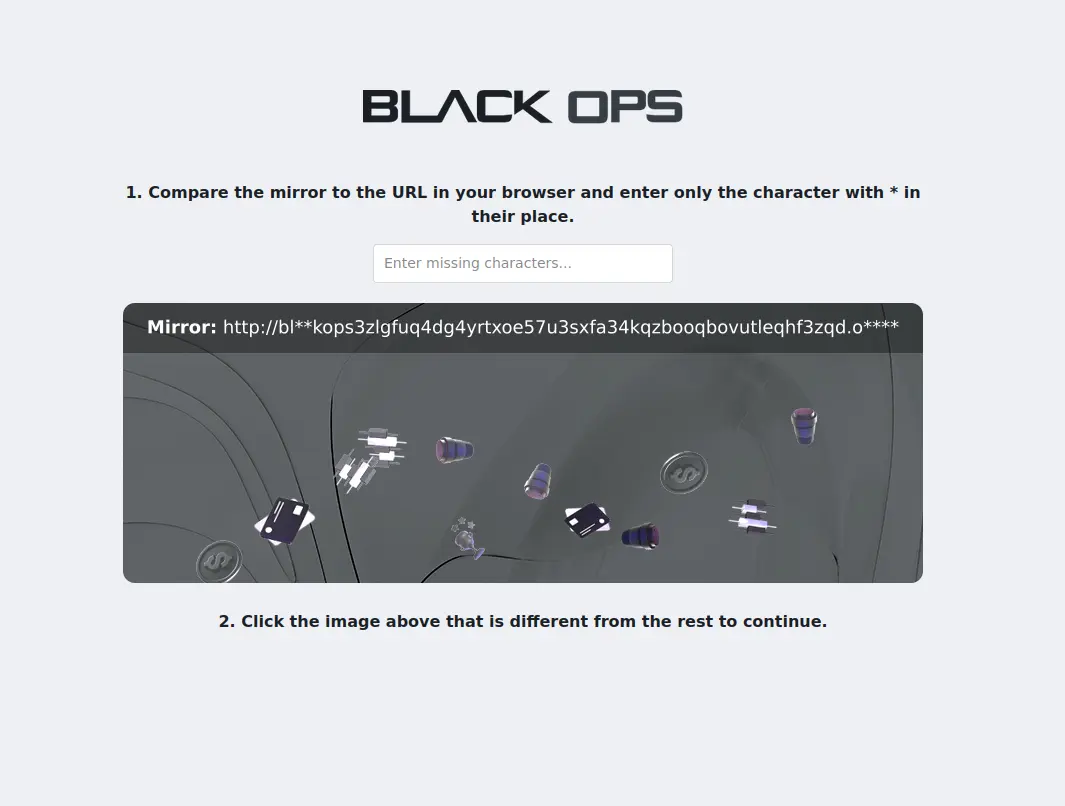
Always cross-reference any .onion address against the PGP-signed mirror list published by BlackOps Market administration. Import the official PGP public key and verify the signature on the announcement before trusting any address. Phishing clones often differ by one or two characters in the 56-character address — never trust an address received through forums, direct messages, or third-party sites without PGP verification. Bookmark verified mirrors directly in Tor Browser after confirming their authenticity.